

Every Bond film from GoldenEye (1995) through No Time to Die (2021) featured the Seamaster Diver 300M — 26 consecutive years of on-screen presence.
Omega’s relationship with 007 predates the Diver 300M, but earlier Bond films used Rolex. The switch to Omega came with GoldenEye and has held ever since. Daniel Craig’s four outings — Casino Royale (2006), Quantum of Solace (2008), Skyfall (2012), and No Time to Die (2021) — each used Diver 300M variants, the watch adapting in tone from Brosnan’s suave blue dial to Craig’s more utilitarian titanium and NATO finish.
The official 007 limited editions
Officially licensed Bond editions have multiplied since 2012. The 50 Years of 007 edition was released alongside Skyfall, featuring a limited dial treatment referencing five decades of Bond films. The Commander’s Watch followed in 2017, though collectors should note that reference (232.32.46.51.01.001) used a 45mm Planet Ocean case, not the Diver 300M. This causes persistent confusion in secondary market listings, and confusion costs money.
The No Time to Die Titanium edition (reference 210.90.42.20.01.001, 2020) is the most technically distinctive Bond edition to date. It uses a grade 2 titanium case with tantalum PVD treatment and a khaki NATO strap, a genuine departure from the standard steel construction. The Casino Royale 60th Anniversary edition (2023) commemorated Ian Fleming’s 1953 novel, limited to 7,007 pieces on a blue leather strap.
Personally, I think collectors overpay for the numbered Bond editions. The 2531.80 worn in GoldenEye was never a limited edition — its rarity today is purely accidental, which makes a clean example far more interesting than any deliberately scarce commemorative release. For owners looking to echo the original blue-dial aesthetic, a blue rubber strap with folding buckle captures that look on any generation. Those who prefer the darker No Time to Die register can browse the full range of rubber straps for Omega for every colour option.
Reference by reference: every generation of the Seamaster 300M explained

Omega Seamaster 300M reference evolution comparison blue dial ceramic bezel vs aluminium bezel detail editorial moody studio
The Seamaster Diver 300M has gone through six meaningful generations in thirty years. Each is identifiable by case changes, movement upgrades, or bezel material, and each occupies a distinct collector bracket on the secondary market.
| Reference | Years | Movement | Bezel material | Case size | Key distinction |
|---|---|---|---|---|---|
| 2541.80 | 1993 | Quartz | Aluminium | 41mm | Launch reference; establishes original design language |
| 2531.80 | 1995 | Cal. 1120 (auto) | Aluminium | 41mm | First automatic; the GoldenEye Bond reference |
| 2254.50 | 2000 | Cal. 1120 | Aluminium (brushed) | 41mm | Pre-ceramic era; slight case refinement |
| 2220.80 | 2005 | Cal. 2500 (co-axial) | Aluminium | 41mm | First co-axial escapement in the 300M line |
| 212.30.41.20.03.001 | 2012 | Cal. 8507/8508 | Ceramic (first generation) | 41mm | Ceramic bezel debut; Master Co-Axial movement |
| 210.30.42.20.01.001 | 2018–present | Cal. 8800 | Ceramic | 42mm | METAS Master Chronometer; anti-magnetism to 15,000 gauss |
The single most visible collector demarcation is the shift from aluminium to ceramic bezels in 2012. Pre-2012 references wear differently: the aluminium insert fades and scratches over time, which is patina or a problem depending on the buyer. Skip the quartz 2541.80 entirely unless you’re a completist — it feels cheap next to even the earliest automatics, and the Cal. 1120 references are what made the line worth caring about. For pre-ceramic references, a black calf leather strap suits the slightly softer aesthetic well.
The 2018 generation is a clean improvement over the 2012 version in every way that counts: Calibre 8800 over 8507, METAS certification over COSC, and the five-link bracelet with a patented Seamaster clasp offering 5mm of diver extension. One useful detail: the end-links on the 2018 bracelet are a snugger fit to the case than on the 2012 generation, with noticeably less play. It’s a small thing that changes how the watch feels on the wrist. A quality stainless steel folding buckle is the right call for anyone fitting an aftermarket strap to any generation.
Inside the Calibre 8800: what METAS certification actually means

Omega Calibre 8800 movement close-up macro detail rotor balance wheel studio lighting on dark surface
This is where the 300M gets genuinely interesting from a technical standpoint. The Calibre 8800 uses Omega’s co-axial escapement, a silicon hairspring, and a free-sprung balance. The silicon hairspring is inherently non-magnetic and eliminates the need for Nivarox alloys, which are vulnerable to magnetic fields.
METAS certification goes meaningfully beyond standard COSC chronometer testing. COSC tests the movement outside the case, to a tolerance of -4/+6 seconds per day. METAS tests the complete cased watch across eight distinct checks, including operation inside a 15,000-gauss magnetic field. The accuracy requirement for the cased watch is 0 to +5 seconds per day — tighter than COSC and measured in real-world conditions.
METAS tests the watch inside a 15,000-gauss magnetic field. A standard MRI scanner produces approximately 15,000 gauss. The Calibre 8800 is designed to keep running accurately through it.
The practical ownership benefit is a recommended service interval of 8–10 years, longer than the older Calibre 2500, which required service every 5–7 years. The Calibre 8800 also appears in the Planet Ocean 600M and select Aqua Terra references, so any watchmaker familiar with Omega’s sport range will know the movement. One thing often overlooked at service time: ask the watchmaker to inspect the bracelet clasp while the strap is already off the watch. A worn deployant is an easy fix when it’s in hand, and an annoying one to deal with separately.
Calibre 8800 at a glance: Co-axial escapement, silicon hairspring, anti-magnetism to 15,000 gauss, METAS Master Chronometer certified, 0/+5 seconds per day, 8–10 year service interval.
Seamaster 300M vs Rolex Submariner: an honest comparison

Omega Seamaster 300M blue dial next to Rolex Submariner comparison detail close-up on dark slate surface editorial light
This is the most-asked question in the dive-watch category, and it deserves a direct answer. Both watches are legitimate professional dive tools with in-house movements, ceramic bezels, and 300m water resistance ratings. The differences are meaningful rather than decisive.
| Specification | Seamaster 300M (Cal. 8800) | Rolex Submariner (Cal. 3235) |
|---|---|---|
| Case diameter | 42mm | 41mm (current ref.) |
| Water resistance | 300m / 30 bar | 300m / 30 bar |
| Movement | Calibre 8800 | Calibre 3235 |
| Escapement | Co-axial | Lever escapement |
| Bezel material | Ceramic | Ceramic |
| Anti-magnetism | 15,000 gauss | Not rated to equivalent standard |
| Bracelet adjustment | 5mm diver extension in clasp | Glidelock micro-adjustment |
| Recommended service | 8–10 years | Approx. 10 years (Rolex recommendation) |
| Certification standard | METAS Master Chronometer | Rolex Superlative Chronometer |
| Helium escape valve | Yes | No (standard refs.) |
On the secondary market, the Submariner retains value more aggressively. The Seamaster 300M depreciates more typically for a Swiss luxury watch — which for buyers purchasing to wear rather than invest is arguably an advantage. The 42mm vs 41mm case size difference is visible on smaller wrists; try both before deciding.
Movement philosophy is the real distinction. The Rolex Calibre 3235 uses a lever escapement: proven, robust, very easy to service anywhere in the world. Omega’s Calibre 8800 uses a co-axial escapement with a silicon hairspring, offering longer service intervals and superior anti-magnetism. Neither is objectively better; they represent two different engineering schools. One area where the Seamaster wins outright is strap variety. The aftermarket for the 300M is far wider than anything the Submariner commands — you can browse the full rubber strap range for Omega to get a sense of the options, including a dark green rubber strap that inhabits Submariner Kermit territory aesthetically.
Buying a pre-owned Seamaster 300M: which reference and what to check

Omega Seamaster 300M pre-owned vintage reference 2531.80 blue dial with tritium lume close-up macro on weathered wood natural light
If you’re shopping pre-owned, this next section is where most buyers get burned. The 300M pre-owned market is deep and well-supplied, which means plenty of good deals — and plenty of traps.
The most sought-after vintage reference is the 2531.80. Original blue dials with tritium lume plots command premiums, particularly in unworn or lightly worn condition with box and papers. For Bond edition references, the numbered certificate cards inside original boxes have a measurable effect on resale price. Without them, expect to negotiate accordingly.
- Check the crown seals: a service history that documents seal replacement is a strongly positive sign on any generation.
- Inspect the bracelet for mid-link stretch, a known wear point across all generations, particularly on examples worn daily over several years.
- Confirm the helium escape valve turns and seats correctly. A loose or damaged valve is a common post-service oversight and a water resistance risk.
- On 2018-generation examples, check Omega’s online warranty registration tool — many pre-owned examples still carry residual manufacturer warranty.
- Box and papers on Bond edition references (2531.80 and 210.90.42.20.01.001 particularly) have a measurable effect on asking price.
When inspecting any pre-ceramic reference (pre-2012), examine the aluminium bezel insert under good light. Fading, delamination, and colour shift are common on examples that have seen sunlight or salt water. This is cosmetic rather than functional, but it affects value and cannot easily be reversed without full bezel replacement.
Buyers who want the modern aesthetic without the current retail premium should look at 2012-era ceramic bezel references. These offer the clean, chip-resistant bezel of the current generation at a meaningful discount. When a pre-owned example arrives, replacing the strap is often the first practical step: a dark brown calf leather strap works well with the warm tones of older references, and a light brown calf leather option from the Omega leather strap range suits tritium-dial 2531.80 references particularly well.
The 007 limited editions: a collector’s timeline
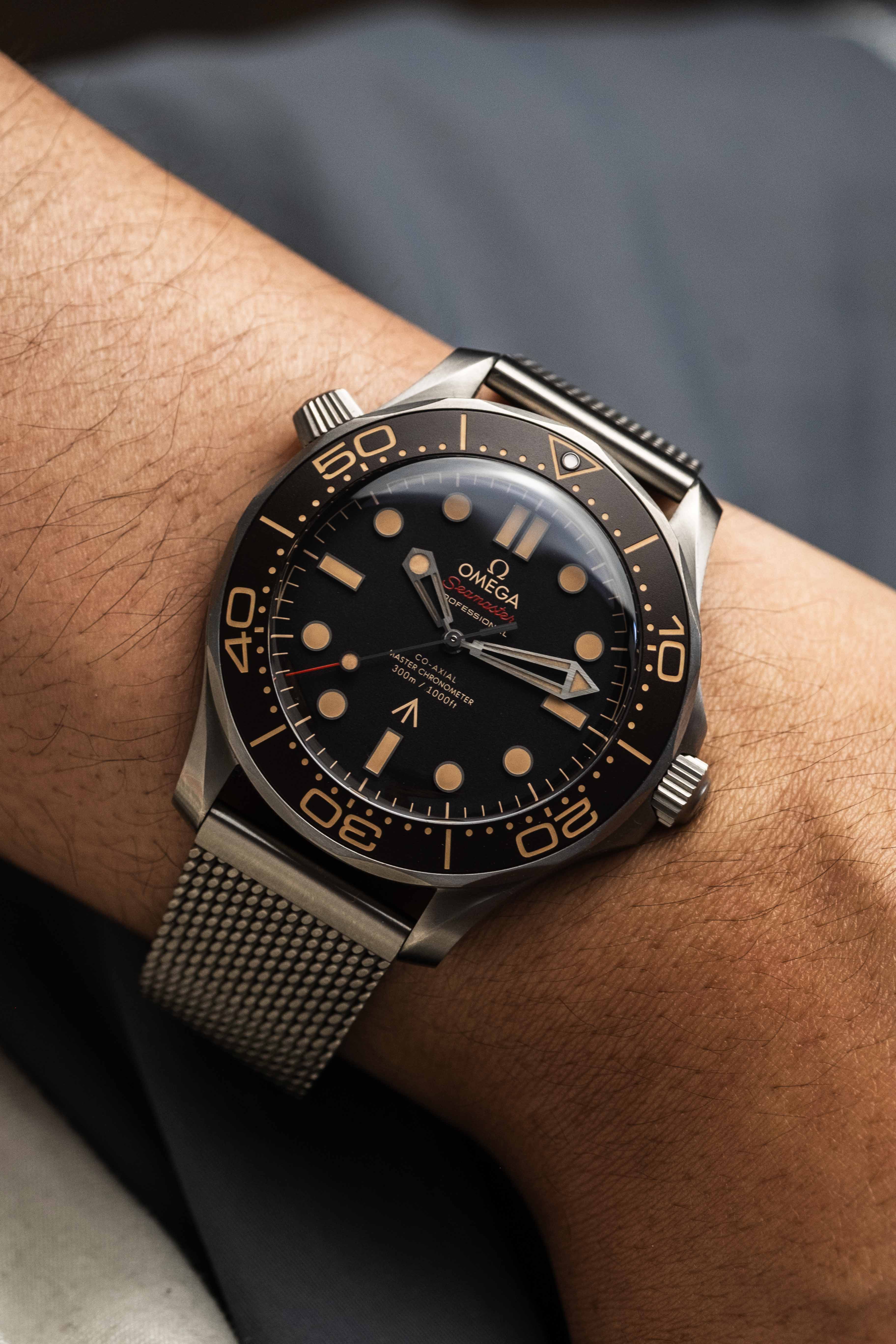
Omega Seamaster 300M No Time to Die titanium reference 210.90.42.20.01.001 khaki NATO strap editorial detail desert light
Omega has produced a string of officially licensed 007 editions since the early 2000s. For collectors, knowing which editions used the Diver 300M and which used other Seamaster lines is the difference between a good buy and an expensive mistake.
The key Bond editions
- 50 Years of 007 (2012): Released alongside Skyfall, featuring a limited dial treatment referencing five decades of Bond films. Calibre 8507 movement.
- Commander’s Watch (2017, ref. 232.32.46.51.01.001): A 45mm Planet Ocean case — not the Diver 300M. Collectors regularly conflate this with the 300M line. The NATO strap and military aesthetic cause the confusion.
- No Time to Die Titanium (2020, ref. 210.90.42.20.01.001): Grade 2 titanium case with tantalum PVD, khaki NATO strap, 42mm. The most technically distinctive Bond edition, and the most clearly a Diver 300M. Calibre 8806 movement.
- Casino Royale 60th Anniversary (2023): Commemorates Ian Fleming’s 1953 novel. Limited to 7,007 pieces on a blue leather strap. METAS Master Chronometer specification.
All Bond editions since 2012 carry Master Co-Axial or METAS-level movement specifications. Original numbered certificate cards inside factory boxes are needed for full value retention on any of them. The 2531.80 worn in GoldenEye was never a limited edition, making unworn examples especially significant: they survived on luck rather than intent, which is what actually makes them rare.
For collectors who want to match the aesthetic of the No Time to Die edition, a black rubber strap captures the dark, operational register of that reference without the NATO routing. For the earlier blue-dial Bond editions and the Casino Royale Anniversary piece, a blue rubber strap from the Omega rubber strap range is the natural aftermarket complement.
Strap options for the Seamaster 300M: rubber, NATO, leather, and steel

Omega Seamaster Diver 300M on dark green rubber strap close-up macro detail on slate surface natural light
All Seamaster Diver 300M references from 1993 to present use a 20mm lug width. This consistency across thirty years of production means strap compatibility is entirely straightforward: one size fits the whole line.
Factory options have always included the stainless steel five-link bracelet, a rubber strap with folding buckle, and on Bond editions, NATO straps. The rubber strap is the most practical choice for actual diving: it does not absorb water, dries instantly, and resists salt degradation in ways that leather cannot. Rubber does degrade over time with UV and ozone exposure — even unworn examples stored in direct light will crack within a decade, so replacement is a periodic ownership cost rather than an optional upgrade.
Rubber straps
For the current generation’s blue-dial aesthetic, the dark green rubber strap is a popular alternative to the factory blue. For the canonical look, a blue rubber strap with folding buckle matches the original design intent. Browse the full range of rubber straps for Omega for every colour option across the Seamaster range.
Leather straps
Leather straps on a dive watch are an aesthetic choice rather than a functional one. They suit older tritium-dial references worn casually rather than operationally. A dark brown calf leather strap pairs well with warm-toned vintage dials. The full selection of leather straps for Omega covers multiple shades and finishes for the 300M.
NATO straps and clasps
A NATO strap routes between the case and spring bars, distributing load across both bars rather than relying on a single pair — more secure in the water than a standard two-spring-bar setup. The folding deployant clasp is the recommended buckle type for dive watches: it eliminates the risk of a tang buckle snagging and releasing underwater. The buckles and clasps category covers all Omega-compatible options.
Parts and accessories for your Seamaster 300M

Frequently asked questions
Common questions buyers and collectors ask before committing.
Is the Omega Seamaster 300M the James Bond watch?
Yes. Since GoldenEye (1995), every James Bond film has featured Pierce Brosnan or Daniel Craig wearing a Seamaster Diver 300M. Omega has released several officially licensed 007 editions over the years, including the No Time to Die titanium on NATO strap (reference 210.92.42.20.01.001).
How often should an Omega Seamaster 300M be serviced?
Omega recommends servicing every 8 to 10 years for the current Master Chronometer generation (Calibre 8800). Earlier Seamaster 300M references with the Calibre 1120 or 2500 typically want service every 5 to 7 years. Intervals depend on use, water exposure, and any observed behavioural changes like power reserve drop-off.
What is the difference between the Seamaster 300M and the Planet Ocean?
The Seamaster Diver 300M (41mm or 42mm, 300m water resistance) is the slimmer everyday dive watch and the official James Bond reference. The Planet Ocean is a beefier professional diver (42mm, 43.5mm or 45.5mm; 600m water resistance) built for deeper saturation dives. The 300M is easier to wear daily; the Planet Ocean is the tool piece.
Can I replace the strap or bracelet on my Seamaster 300M myself?
The 20mm lug width gives you many options. The screwed-link stainless steel bracelet needs a small screwdriver. Curved rubber straps like our dedicated Seamaster fitment and canvas NATO straps are a bolt-on swap with a spring-bar tool. We recommend a professional for any bracelet that has lost end-link tension.
How do I authenticate a pre-owned Seamaster 300M?
Check the reference engraving on the caseback against the movement calibre (e.g., 210.30.42.20.01.001 with Calibre 8800). Verify the serial number date via Omega’s online extract service. Inspect the ceramic bezel for factory sharpness, check bracelet end-link fit, listen for a clean unidirectional bezel click, and confirm the helium escape valve turns smoothly. Buy from dealers who offer independent authentication where possible.
Thirty years on from its 1993 launch, the Seamaster Diver 300M remains one of the most technically credible and culturally loaded dive watches in production. This guide covers every generation, every Bond connection, and everything you need to own one properly.
In short. Everything on the Omega Seamaster 300M — from GoldenEye references to Calibre 8800, key variants, Seamaster vs Submariner comparisons, and the parts and straps you need to keep it in top condition.
What is the Omega Seamaster 300M and why does it matter?

Omega Seamaster Diver 300M 42mm blue ceramic bezel wave dial editorial detail on linen fabric
The Seamaster Diver 300M is a specific line within Omega’s broader Seamaster family. Being precise here matters: the Planet Ocean is a larger, 600m-rated tool watch; the Aqua Terra is a non-diving dress-sport piece. The Diver 300M sits between those as a genuine professional dive watch with 30 bar (300 metre) water resistance and ISO 6425 certification.
Current production sits at 42mm with a unidirectional ceramic bezel, a helium escape valve at 10 o’clock for saturation diving, and the wave-pattern dial that has defined the line since 1993. That textured, horizontally rippled surface is one of the most instantly recognisable design signatures in the category — and, for what it’s worth, the blue dial is the one to buy. It wears differently in different light in a way the black simply doesn’t.
The watch is rated to 984 feet and certified for professional saturation diving use. That’s a functional specification backed by third-party testing, not a marketing claim. For collectors new to the line, the aftermarket ecosystem is one of the most well-supported in the Omega range — a dark green rubber strap gives an immediate sense of that variety.
Key specs (current generation): 42mm case, 300m water resistance, helium escape valve, ceramic bezel, Calibre 8800, METAS Master Chronometer certified, 20mm lug width.
Bond, the British military, and 30 years of cultural history
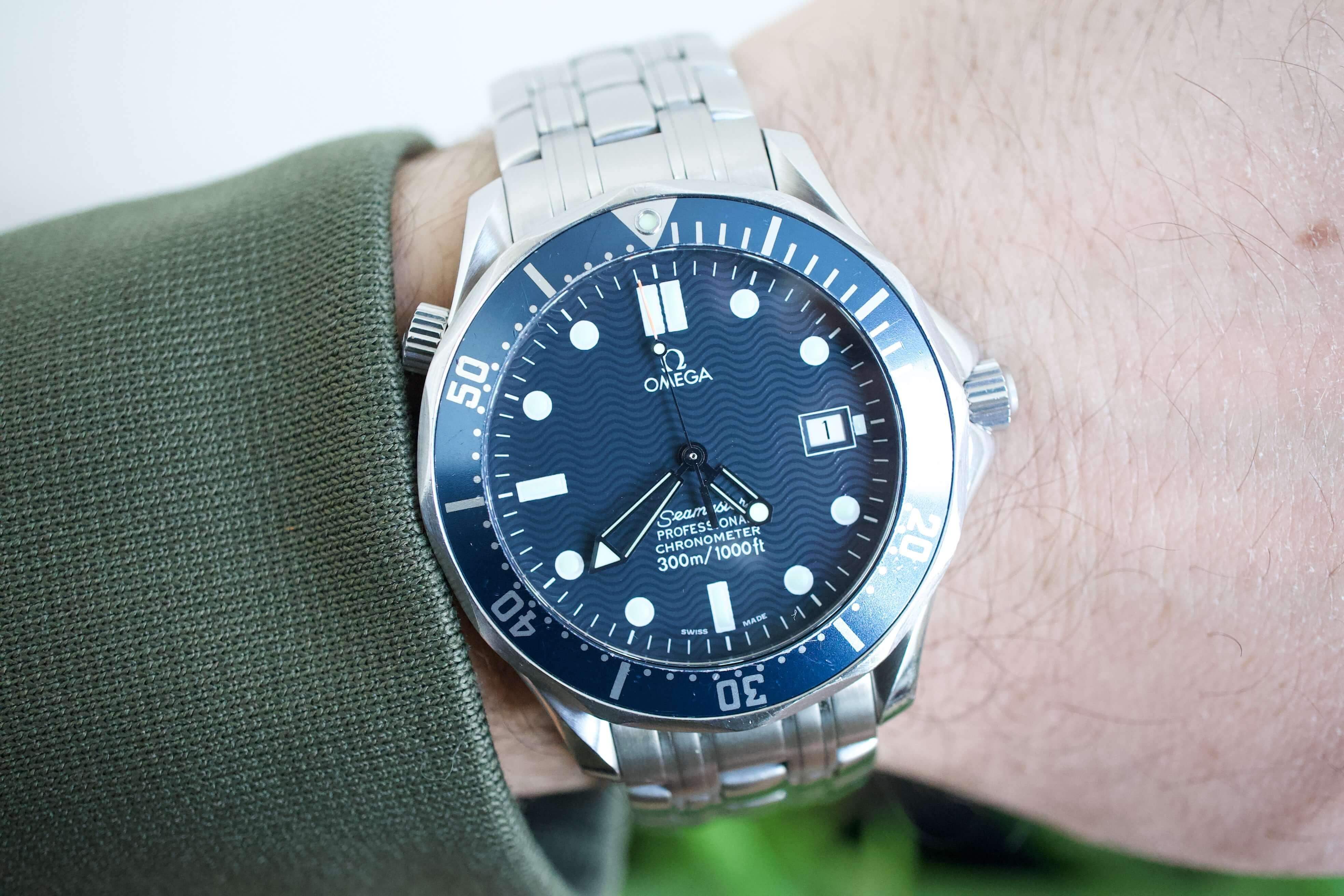
Omega Seamaster Diver 300M reference 2531.80 GoldenEye 1995 vintage blue dial close-up on leather surface moody studio light
The Seamaster Diver 300M did not arrive as a marketing exercise dressed in dive-watch clothing. Its 1993 launch involved co-engineering input from the British military and the professional dive community, resulting in a watch that met actual operational requirements before it appeared in any shop window.
The cultural watershed came two years later. When Pierce Brosnan needed a watch for GoldenEye (1995) that could plausibly sit on a Royal Navy commander’s wrist, Omega had the answer: reference 2531.80, the first automatic Seamaster Diver 300M, fitted with a blue wave dial and matching bezel. It was a standard production watch, not a hero prop, and that detail matters enormously to collectors today. Every Bond film from GoldenEye through No Time to Die (2021) has featured the Diver 300M on screen, across three actors and six films.
Every Bond film from GoldenEye (1995) through No Time to Die (2021) featured the Seamaster Diver 300M — 26 consecutive years of on-screen presence.
Omega’s relationship with 007 predates the Diver 300M, but earlier Bond films used Rolex. The switch to Omega came with GoldenEye and has held ever since. Daniel Craig’s four outings — Casino Royale (2006), Quantum of Solace (2008), Skyfall (2012), and No Time to Die (2021) — each used Diver 300M variants, the watch adapting in tone from Brosnan’s suave blue dial to Craig’s more utilitarian titanium and NATO finish.
The official 007 limited editions
Officially licensed Bond editions have multiplied since 2012. The 50 Years of 007 edition was released alongside Skyfall, featuring a limited dial treatment referencing five decades of Bond films. The Commander’s Watch followed in 2017, though collectors should note that reference (232.32.46.51.01.001) used a 45mm Planet Ocean case, not the Diver 300M. This causes persistent confusion in secondary market listings, and confusion costs money.
The No Time to Die Titanium edition (reference 210.90.42.20.01.001, 2020) is the most technically distinctive Bond edition to date. It uses a grade 2 titanium case with tantalum PVD treatment and a khaki NATO strap, a genuine departure from the standard steel construction. The Casino Royale 60th Anniversary edition (2023) commemorated Ian Fleming’s 1953 novel, limited to 7,007 pieces on a blue leather strap.
Personally, I think collectors overpay for the numbered Bond editions. The 2531.80 worn in GoldenEye was never a limited edition — its rarity today is purely accidental, which makes a clean example far more interesting than any deliberately scarce commemorative release. For owners looking to echo the original blue-dial aesthetic, a blue rubber strap with folding buckle captures that look on any generation. Those who prefer the darker No Time to Die register can browse the full range of rubber straps for Omega for every colour option.
Reference by reference: every generation of the Seamaster 300M explained
Omega Seamaster 300M reference evolution comparison blue dial ceramic bezel vs aluminium bezel detail editorial moody studio
The Seamaster Diver 300M has gone through six meaningful generations in thirty years. Each is identifiable by case changes, movement upgrades, or bezel material, and each occupies a distinct collector bracket on the secondary market.
| Reference | Years | Movement | Bezel material | Case size | Key distinction |
|---|---|---|---|---|---|
| 2541.80 | 1993 | Quartz | Aluminium | 41mm | Launch reference; establishes original design language |
| 2531.80 | 1995 | Cal. 1120 (auto) | Aluminium | 41mm | First automatic; the GoldenEye Bond reference |
| 2254.50 | 2000 | Cal. 1120 | Aluminium (brushed) | 41mm | Pre-ceramic era; slight case refinement |
| 2220.80 | 2005 | Cal. 2500 (co-axial) | Aluminium | 41mm | First co-axial escapement in the 300M line |
| 212.30.41.20.03.001 | 2012 | Cal. 8507/8508 | Ceramic (first generation) | 41mm | Ceramic bezel debut; Master Co-Axial movement |
| 210.30.42.20.01.001 | 2018–present | Cal. 8800 | Ceramic | 42mm | METAS Master Chronometer; anti-magnetism to 15,000 gauss |
The single most visible collector demarcation is the shift from aluminium to ceramic bezels in 2012. Pre-2012 references wear differently: the aluminium insert fades and scratches over time, which is patina or a problem depending on the buyer. Skip the quartz 2541.80 entirely unless you’re a completist — it feels cheap next to even the earliest automatics, and the Cal. 1120 references are what made the line worth caring about. For pre-ceramic references, a black calf leather strap suits the slightly softer aesthetic well.
The 2018 generation is a clean improvement over the 2012 version in every way that counts: Calibre 8800 over 8507, METAS certification over COSC, and the five-link bracelet with a patented Seamaster clasp offering 5mm of diver extension. One useful detail: the end-links on the 2018 bracelet are a snugger fit to the case than on the 2012 generation, with noticeably less play. It’s a small thing that changes how the watch feels on the wrist. A quality stainless steel folding buckle is the right call for anyone fitting an aftermarket strap to any generation.
Inside the Calibre 8800: what METAS certification actually means

Omega Calibre 8800 movement close-up macro detail rotor balance wheel studio lighting on dark surface
This is where the 300M gets genuinely interesting from a technical standpoint. The Calibre 8800 uses Omega’s co-axial escapement, a silicon hairspring, and a free-sprung balance. The silicon hairspring is inherently non-magnetic and eliminates the need for Nivarox alloys, which are vulnerable to magnetic fields.
METAS certification goes meaningfully beyond standard COSC chronometer testing. COSC tests the movement outside the case, to a tolerance of -4/+6 seconds per day. METAS tests the complete cased watch across eight distinct checks, including operation inside a 15,000-gauss magnetic field. The accuracy requirement for the cased watch is 0 to +5 seconds per day — tighter than COSC and measured in real-world conditions.
METAS tests the watch inside a 15,000-gauss magnetic field. A standard MRI scanner produces approximately 15,000 gauss. The Calibre 8800 is designed to keep running accurately through it.
The practical ownership benefit is a recommended service interval of 8–10 years, longer than the older Calibre 2500, which required service every 5–7 years. The Calibre 8800 also appears in the Planet Ocean 600M and select Aqua Terra references, so any watchmaker familiar with Omega’s sport range will know the movement. One thing often overlooked at service time: ask the watchmaker to inspect the bracelet clasp while the strap is already off the watch. A worn deployant is an easy fix when it’s in hand, and an annoying one to deal with separately.
Calibre 8800 at a glance: Co-axial escapement, silicon hairspring, anti-magnetism to 15,000 gauss, METAS Master Chronometer certified, 0/+5 seconds per day, 8–10 year service interval.
Seamaster 300M vs Rolex Submariner: an honest comparison
Omega Seamaster 300M blue dial next to Rolex Submariner comparison detail close-up on dark slate surface editorial light
This is the most-asked question in the dive-watch category, and it deserves a direct answer. Both watches are legitimate professional dive tools with in-house movements, ceramic bezels, and 300m water resistance ratings. The differences are meaningful rather than decisive.
| Specification | Seamaster 300M (Cal. 8800) | Rolex Submariner (Cal. 3235) |
|---|---|---|
| Case diameter | 42mm | 41mm (current ref.) |
| Water resistance | 300m / 30 bar | 300m / 30 bar |
| Movement | Calibre 8800 | Calibre 3235 |
| Escapement | Co-axial | Lever escapement |
| Bezel material | Ceramic | Ceramic |
| Anti-magnetism | 15,000 gauss | Not rated to equivalent standard |
| Bracelet adjustment | 5mm diver extension in clasp | Glidelock micro-adjustment |
| Recommended service | 8–10 years | Approx. 10 years (Rolex recommendation) |
| Certification standard | METAS Master Chronometer | Rolex Superlative Chronometer |
| Helium escape valve | Yes | No (standard refs.) |
On the secondary market, the Submariner retains value more aggressively. The Seamaster 300M depreciates more typically for a Swiss luxury watch — which for buyers purchasing to wear rather than invest is arguably an advantage. The 42mm vs 41mm case size difference is visible on smaller wrists; try both before deciding.
Movement philosophy is the real distinction. The Rolex Calibre 3235 uses a lever escapement: proven, robust, very easy to service anywhere in the world. Omega’s Calibre 8800 uses a co-axial escapement with a silicon hairspring, offering longer service intervals and superior anti-magnetism. Neither is objectively better; they represent two different engineering schools. One area where the Seamaster wins outright is strap variety. The aftermarket for the 300M is far wider than anything the Submariner commands — you can browse the full rubber strap range for Omega to get a sense of the options, including a dark green rubber strap that inhabits Submariner Kermit territory aesthetically.
Buying a pre-owned Seamaster 300M: which reference and what to check
Omega Seamaster 300M pre-owned vintage reference 2531.80 blue dial with tritium lume close-up macro on weathered wood natural light
If you’re shopping pre-owned, this next section is where most buyers get burned. The 300M pre-owned market is deep and well-supplied, which means plenty of good deals — and plenty of traps.
The most sought-after vintage reference is the 2531.80. Original blue dials with tritium lume plots command premiums, particularly in unworn or lightly worn condition with box and papers. For Bond edition references, the numbered certificate cards inside original boxes have a measurable effect on resale price. Without them, expect to negotiate accordingly.
- Check the crown seals: a service history that documents seal replacement is a strongly positive sign on any generation.
- Inspect the bracelet for mid-link stretch, a known wear point across all generations, particularly on examples worn daily over several years.
- Confirm the helium escape valve turns and seats correctly. A loose or damaged valve is a common post-service oversight and a water resistance risk.
- On 2018-generation examples, check Omega’s online warranty registration tool — many pre-owned examples still carry residual manufacturer warranty.
- Box and papers on Bond edition references (2531.80 and 210.90.42.20.01.001 particularly) have a measurable effect on asking price.
When inspecting any pre-ceramic reference (pre-2012), examine the aluminium bezel insert under good light. Fading, delamination, and colour shift are common on examples that have seen sunlight or salt water. This is cosmetic rather than functional, but it affects value and cannot easily be reversed without full bezel replacement.
Buyers who want the modern aesthetic without the current retail premium should look at 2012-era ceramic bezel references. These offer the clean, chip-resistant bezel of the current generation at a meaningful discount. When a pre-owned example arrives, replacing the strap is often the first practical step: a dark brown calf leather strap works well with the warm tones of older references, and a light brown calf leather option from the Omega leather strap range suits tritium-dial 2531.80 references particularly well.
The 007 limited editions: a collector’s timeline
Omega Seamaster 300M No Time to Die titanium reference 210.90.42.20.01.001 khaki NATO strap editorial detail desert light
Omega has produced a string of officially licensed 007 editions since the early 2000s. For collectors, knowing which editions used the Diver 300M and which used other Seamaster lines is the difference between a good buy and an expensive mistake.
The key Bond editions
- 50 Years of 007 (2012): Released alongside Skyfall, featuring a limited dial treatment referencing five decades of Bond films. Calibre 8507 movement.
- Commander’s Watch (2017, ref. 232.32.46.51.01.001): A 45mm Planet Ocean case — not the Diver 300M. Collectors regularly conflate this with the 300M line. The NATO strap and military aesthetic cause the confusion.
- No Time to Die Titanium (2020, ref. 210.90.42.20.01.001): Grade 2 titanium case with tantalum PVD, khaki NATO strap, 42mm. The most technically distinctive Bond edition, and the most clearly a Diver 300M. Calibre 8806 movement.
- Casino Royale 60th Anniversary (2023): Commemorates Ian Fleming’s 1953 novel. Limited to 7,007 pieces on a blue leather strap. METAS Master Chronometer specification.
All Bond editions since 2012 carry Master Co-Axial or METAS-level movement specifications. Original numbered certificate cards inside factory boxes are needed for full value retention on any of them. The 2531.80 worn in GoldenEye was never a limited edition, making unworn examples especially significant: they survived on luck rather than intent, which is what actually makes them rare.
For collectors who want to match the aesthetic of the No Time to Die edition, a black rubber strap captures the dark, operational register of that reference without the NATO routing. For the earlier blue-dial Bond editions and the Casino Royale Anniversary piece, a blue rubber strap from the Omega rubber strap range is the natural aftermarket complement.
Strap options for the Seamaster 300M: rubber, NATO, leather, and steel

Omega Seamaster Diver 300M on dark green rubber strap close-up macro detail on slate surface natural light
All Seamaster Diver 300M references from 1993 to present use a 20mm lug width. This consistency across thirty years of production means strap compatibility is entirely straightforward: one size fits the whole line.
Factory options have always included the stainless steel five-link bracelet, a rubber strap with folding buckle, and on Bond editions, NATO straps. The rubber strap is the most practical choice for actual diving: it does not absorb water, dries instantly, and resists salt degradation in ways that leather cannot. Rubber does degrade over time with UV and ozone exposure — even unworn examples stored in direct light will crack within a decade, so replacement is a periodic ownership cost rather than an optional upgrade.
Rubber straps
For the current generation’s blue-dial aesthetic, the dark green rubber strap is a popular alternative to the factory blue. For the canonical look, a blue rubber strap with folding buckle matches the original design intent. Browse the full range of rubber straps for Omega for every colour option across the Seamaster range.
Leather straps
Leather straps on a dive watch are an aesthetic choice rather than a functional one. They suit older tritium-dial references worn casually rather than operationally. A dark brown calf leather strap pairs well with warm-toned vintage dials. The full selection of leather straps for Omega covers multiple shades and finishes for the 300M.
NATO straps and clasps
A NATO strap routes between the case and spring bars, distributing load across both bars rather than relying on a single pair — more secure in the water than a standard two-spring-bar setup. The folding deployant clasp is the recommended buckle type for dive watches: it eliminates the risk of a tang buckle snagging and releasing underwater. The buckles and clasps category covers all Omega-compatible options.
Parts and accessories for your Seamaster 300M
Frequently asked questions
Common questions buyers and collectors ask before committing.
Is the Omega Seamaster 300M the James Bond watch?
Yes. Since GoldenEye (1995), every James Bond film has featured Pierce Brosnan or Daniel Craig wearing a Seamaster Diver 300M. Omega has released several officially licensed 007 editions over the years, including the No Time to Die titanium on NATO strap (reference 210.92.42.20.01.001).
How often should an Omega Seamaster 300M be serviced?
Omega recommends servicing every 8 to 10 years for the current Master Chronometer generation (Calibre 8800). Earlier Seamaster 300M references with the Calibre 1120 or 2500 typically want service every 5 to 7 years. Intervals depend on use, water exposure, and any observed behavioural changes like power reserve drop-off.
What is the difference between the Seamaster 300M and the Planet Ocean?
The Seamaster Diver 300M (41mm or 42mm, 300m water resistance) is the slimmer everyday dive watch and the official James Bond reference. The Planet Ocean is a beefier professional diver (42mm, 43.5mm or 45.5mm; 600m water resistance) built for deeper saturation dives. The 300M is easier to wear daily; the Planet Ocean is the tool piece.
Can I replace the strap or bracelet on my Seamaster 300M myself?
The 20mm lug width gives you many options. The screwed-link stainless steel bracelet needs a small screwdriver. Curved rubber straps like our dedicated Seamaster fitment and canvas NATO straps are a bolt-on swap with a spring-bar tool. We recommend a professional for any bracelet that has lost end-link tension.
How do I authenticate a pre-owned Seamaster 300M?
Check the reference engraving on the caseback against the movement calibre (e.g., 210.30.42.20.01.001 with Calibre 8800). Verify the serial number date via Omega’s online extract service. Inspect the ceramic bezel for factory sharpness, check bracelet end-link fit, listen for a clean unidirectional bezel click, and confirm the helium escape valve turns smoothly. Buy from dealers who offer independent authentication where possible.