

Hublot built its entire identity on putting rubber where gold had always been – and never apologised for it. This guide covers every strap and bracelet material in the Hublot catalogue, from vulcanised natural rubber to forged carbon, with lug widths, fitment tables, and the One Click system explained in full.
Why Hublot’s bracelet system is unlike any other
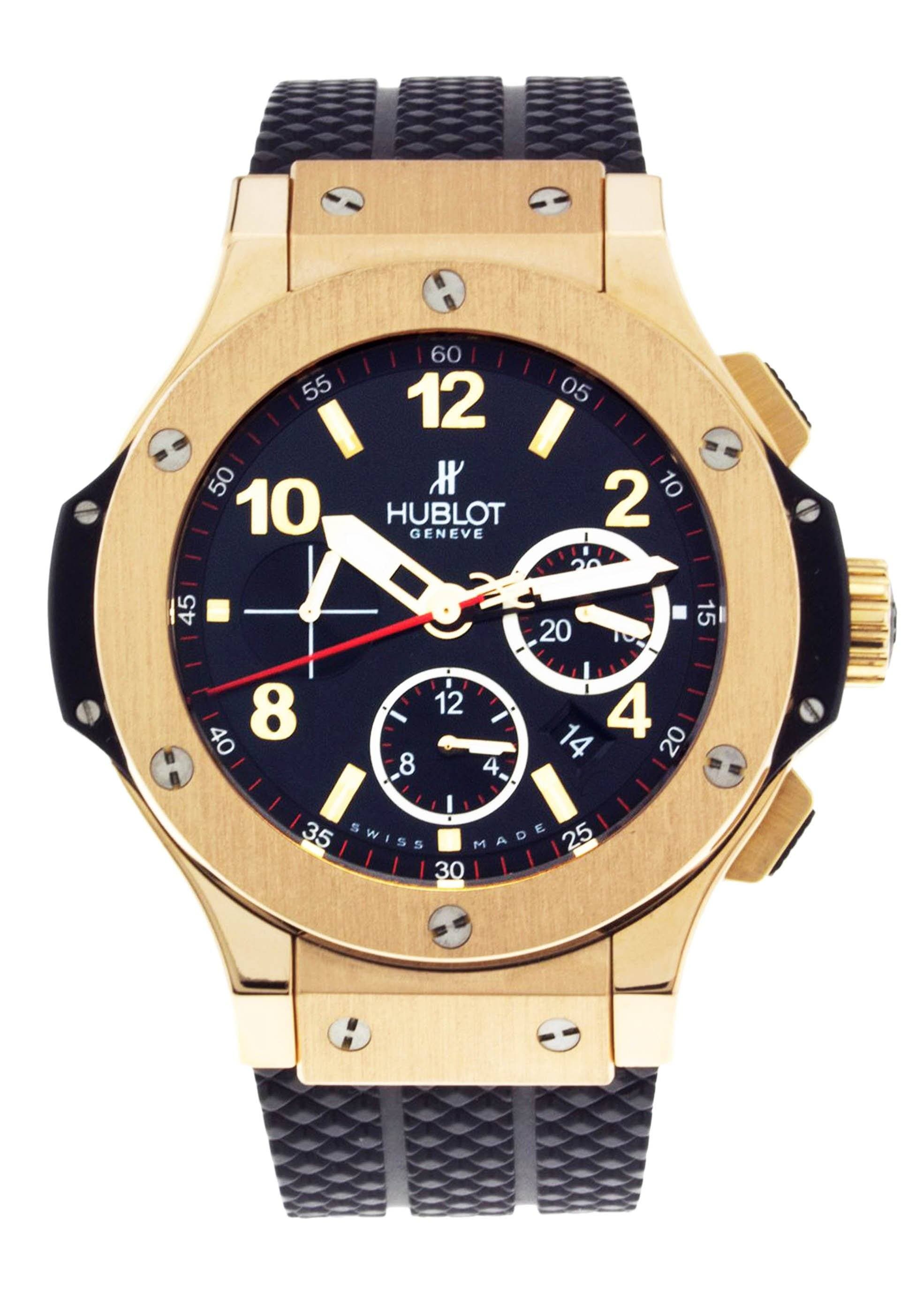
When Carlo Crocco paired a polished gold case with a vulcanised rubber strap in 1980, the Swiss watch establishment treated it as a category error. Precious metal watches wore leather or metal bracelets – that was the rule. Crocco broke it deliberately, and that act of provocation became Hublot’s founding document.
Jean-Claude Biver amplified the idea into a global brand when he relaunched Hublot in 2004 with the Big Bang. The combination of gold, rubber, and exposed case screws was considered scandalous in Geneva at the time – and it won the Best Design prize at the Grand Prix d’Horlogerie de Genève in 2005 anyway.
The brand name itself signals the philosophy. Hublot derives from the French word for porthole, a reference to the circular case screws that ring every bezel. Everything about the watch, including the strap, is treated as a design element to be fused rather than merely attached. That is the “Art of Fusion”, and it explains why Hublot offers more strap materials across more finishes than almost any other Swiss manufacturer.
The Big Bang launched in 2005 and won the Grand Prix d’Horlogerie de Genève Best Design award in its debut year – an almost unheard-of reception for a new reference.
A brief history and the “Art of Fusion” philosophy
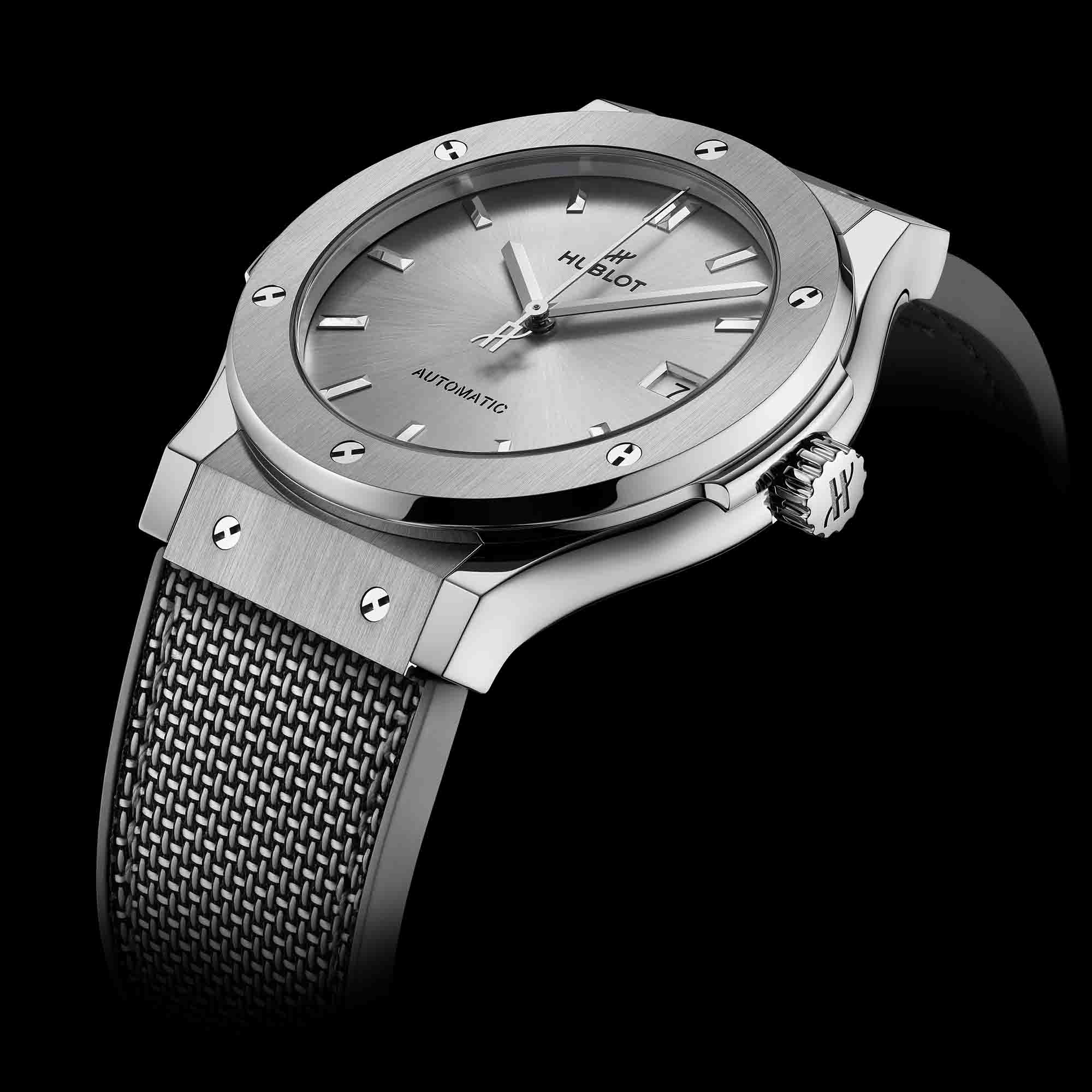
Carlo Crocco founded Hublot in Geneva in 1980. His key idea, a natural rubber strap on a gold case, was technically novel and commercially risky. The watch industry had used rubber for diving watches, but never as a luxury material alongside precious metal at the same price point.
The brand ticked along through the 1980s and 1990s as a niche curiosity. Jean-Claude Biver, who had previously revived Blancpain from near-extinction, took the helm in 2004 and reframed the rubber-on-gold concept not as eccentricity but as a creative manifesto. The Big Bang launched in 2005 and Hublot’s trajectory changed permanently.
LVMH acquired the brand in 2008, providing capital for in-house movement development and advanced materials research. Ricardo Guadalupe became CEO in 2012 and has since extended the sports partnership programme – Formula One, FIFA, the NBA – while also broadening the strap catalogue to include denim, Kevlar, Nomex, and multiple ceramic variants.
The “Art of Fusion” ethos operates as a practical rule: every strap material choice is framed as a deliberate collision of worlds. Rubber with King Gold. Carbon fibre with ceramic. Cordura nylon with grade 5 titanium. The Classic Fusion stainless steel bracelet, for instance, pairs polished link construction with the watch’s characteristically raw, industrial lug geometry – the contrast is entirely intentional.
The rubber strap: Hublot’s founding material and still the default

Vulcanised natural rubber has been on Hublot’s wrists since 1980. It was eccentric then and remains the brand’s most recognisable signature today. Vulcanisation – heating natural rubber with sulphur to cross-link the polymer chains – produces a strap that is far more durable, heat-stable, and elastic than simple synthetic silicone. This is not a small distinction: cheap silicone replacements feel wrong on a Hublot and age badly.
Hublot offers smooth, perforated, and lined rubber variants across its catalogue. The lined version, which bonds a fabric layer to the inner surface, addresses the perspiration issue common to solid rubber in warm weather. For daily sport or summer wear, the lined construction is the more practical choice.
Lug dimensions vary by model family, so getting the measurement right before ordering matters. The standard Big Bang 45mm uses a 27x19mm strap, while smaller variants drop to 26x17mm. The Big Bang King Power uses a wider 29x19mm fitment. UV exposure, sunscreen, and petroleum-based products all accelerate rubber degradation; replace rubber straps every two to three years under regular wear.
Colour options run from conservative black and grey through vivid orange, red, and blue. A red rubber strap for the Big Bang 26x17mm is a popular choice for owners of smaller-case references wanting a bold refresh without changing the watch. The grey rubber strap in 25x19mm sits at the opposite end of the palette – understated and office-friendly – and for sport editions, an orange rubber strap matches the vivid accent colours seen across many Big Bang Sport references.
King Power owners need the correct wider fitment. The brown rubber strap for the King Power 29x19mm is a neutral tone that works across the full King Power colour range.
Lug widths and fitment: which strap fits which Hublot model
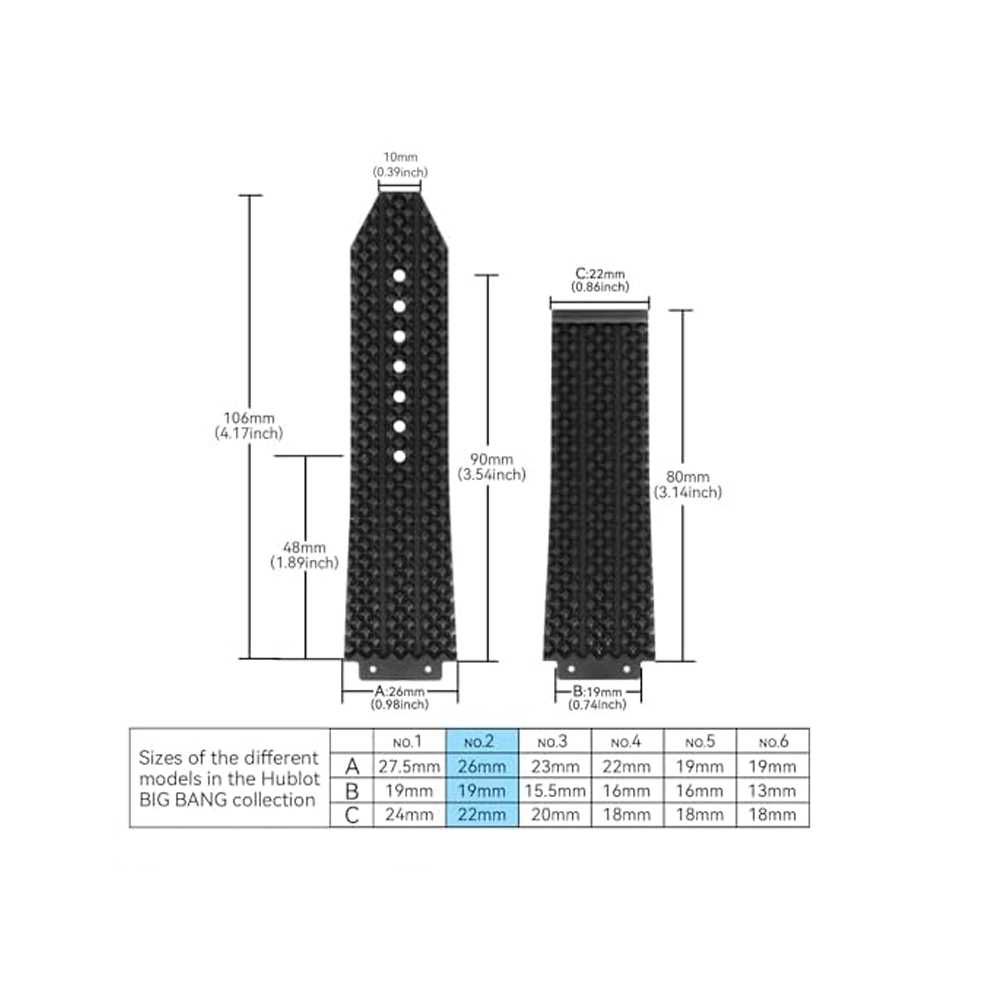
If you’re shopping for a replacement strap, this is where most buyers get burned. Hublot does not use industry-standard lug widths. The numbers across the Big Bang and Classic Fusion families are proprietary, and confusing a 25mm lug with a 27mm or 28mm is an easy ordering mistake with an obvious consequence: the strap either won’t fit or will sit loosely. The table below maps every major reference family to its correct fitment.
| Model family | Case size | Lug width (mm) | Strap taper (wide x narrow) | One Click compatible |
|---|---|---|---|---|
| Big Bang (ref. 411) | 45mm | 28mm | 27x19mm | Selected variants |
| Big Bang (ref. 342) | 41mm | 25mm | 25x19mm | No |
| Big Bang 39mm | 39mm | 25mm | 25x19mm | Yes |
| Big Bang King Power | 48mm | 28-29mm | 27x19mm or 29x19mm | No |
| Big Bang Lady | Various | 21mm or 23mm | 21x15mm or 23x14mm | No |
| Classic Fusion (ref. 565) | 38mm | 21mm | 21x15mm | No |
| Classic Fusion (ref. 541) | 42mm | 22mm | 22x16mm | No |
| Classic Fusion (ref. 525 / 511) | 45mm | 28mm | 27x19mm | No |
| Big Bang Integrated (ref. 421) | 42mm | 28mm (proprietary) | Integrated – non-standard | N/A |
Big Bang Lady owners face two distinct fitments. The white rubber strap for the Lady in 21x15mm suits the most common Lady case size; the white rubber Lady strap in 23x14mm covers the slightly wider variant. Measure the existing strap at the lug end before ordering rather than relying on memory.
The King Power’s wider lug is illustrated by the blue rubber King Power strap in 27x19mm – note that this is a different dimension from the 29x19mm used on later King Power generations. The Big Bang Integrated (ref. 421) uses proprietary integrated bracelet end-links that do not accept standard strap replacements without factory components.
The One Click system: tool-free strap changes explained

This is where the One Click system gets genuinely useful. A spring-loaded button sits on each end-piece; press it and the strap slides cleanly out of the case. The entire swap takes under thirty seconds once the technique is familiar – which makes it one of the more practical innovations in the category.
One Click is primarily associated with Big Bang models built around the 39mm case diameter and selected Classic Fusion editions. Larger Big Bang references – the 44mm and 45mm cases – use traditional spring bars or proprietary pins and are not One Click compatible. This is the most common point of confusion when ordering replacement straps: a strap designed for a standard spring-bar Big Bang will not clip into a One Click housing.
The release button mechanism can become stiff if debris or moisture enters the housing. Periodic cleaning with a soft dry brush around the button recess keeps it operating smoothly. Avoid compressed air at close range, which can force grit further into the spring mechanism. Third-party replacement straps for One Click models must incorporate the correct end-piece geometry to engage the retention spring – a standard tapered strap without the moulded end block will not work.
A blue rubber Big Bang strap in 25x19mm is a reliable colour choice for One Click-compatible Big Bang sizes. For a bolder contrast against steel or titanium cases, browse the full rubber strap range for Hublot to find green and other sport-coloured options in the 25x19mm fitment.
Leather straps on Hublot: alligator, calfskin, and horseback explained

Hublot uses three distinct leather types across its strap range: Louisiana alligator, printed crocodile grain calfskin, and horseback leather. The differences matter both for aesthetics and longevity.
Genuine alligator, used on premium Classic Fusion references such as the Aerofusion Skeleton (ref. 511) and Racing Grey (ref. 541), is cut from the belly skin of a Louisiana alligator. The belly scales are square, relatively uniform, and have a natural sheen that develops over time. Caiman, sometimes offered as a lower-cost substitute by third parties, has a more bony, ossified scale structure that feels stiffer and less supple than true alligator.
Printed crocodile grain calfskin is the most widely available leather option in the aftermarket. The crocodile texture is embossed mechanically onto cow leather rather than harvested from a reptile. The result is highly consistent in scale size and spacing – which is actually the visual tell, since genuine scales are never perfectly regular. Printed grain is more affordable and easier to replace, and for daily wear it performs well. The brown calfskin printed crocodile grain strap for the Unico 411 fits the 45mm Big Bang Unico correctly and provides a dressed-down alternative to the standard rubber. The black version of the same strap is a popular choice for black-dialled or DLC-finished references – if that’s your case, skip the brown and go straight for it.
Horseback leather, taken from the dense hindquarter of the horse, is used across several Big Bang Lady variants. It is notably denser than standard calfskin, tolerates incidental moisture better, and develops a visible patina over years of wear. The grey horseback leather strap for the Lady 21x15mm is a refined option for Classic Fusion-adjacent styling. The full leather strap range for Hublot includes black and brown horseback variants in the same 21x15mm fitment, covering the most-requested tones.
No leather strap should be worn for swimming or sport. Moisture causes leather to stiffen and eventually crack along the stitch lines.
Exotic and unconventional materials: was Hublot first?

Hublot has several documented firsts in materials innovation, and a few that deserve more careful examination. Separating genuine industry firsts from marketing positioning is worth doing.
The strongest claim is Magic Gold, introduced in 2012. This is an alloy of 18-carat gold fused with boron carbide ceramic at the molecular level, producing the first scratch-resistant gold alloy to receive a Swiss precious metal hallmark. Independent testing by Swiss assay offices confirmed the composition. No other manufacturer had registered a scratch-resistant gold alloy under Swiss hallmark law before Hublot.
Forged carbon as a case and strap material arrived at Hublot in 2011. Unlike woven carbon fibre sheet, forged carbon uses chopped carbon strands compressed under heat in a mould – each piece has a unique marbled pattern. Hublot was ahead of most luxury competitors in adopting forged carbon at production scale, though the material was well known in motorsport and aerospace before its watch debut.
King Gold is Hublot’s proprietary rose gold alloy, with a higher copper content than standard 18-carat rose gold. The result is a deeper, redder tone that photographs distinctly from conventional rose gold – visible on references such as the Big Bang Unico King Gold (ref. 411.JX.4802.RT).
The more unconventional strap materials are largely tied to limited editions and collaborations. Hublot has produced straps in denim, Kevlar, perforated Nomex (a fire-resistant aramid fibre used in motorsport suits), velcro-lined sport fabric, and multiple camouflage-patterned rubber variants. The green camouflage rubber strap for the Big Bang 25x17mm is a direct carry-over from Hublot’s military-themed limited editions – and one of the more wearable statement straps in the catalogue.
Black micro-blasted ceramic entered the Big Bang case and integrated bracelet range around 2008. Hublot was one of the earliest Swiss luxury brands to offer ceramic as a standard case material at production scale. The black brushed ceramic bezel for the Big Bang pairs naturally with a matching strap change, and the beige printed hornback leather strap in 25x19mm offers the distinctive ridge pattern of the crocodile’s back spine – a subtler way to add texture against a ceramic case.
Metal bracelets and integrated designs: titanium, steel, and ceramic

Metal bracelets on Hublot fall into two distinct categories: the interchangeable Classic Fusion bracelet family and the proprietary integrated Big Bang Integrated design. They are built to different engineering briefs and suit different wearing contexts.
The Classic Fusion bracelet is available in four PVD finishes to match the case colour of any Classic Fusion reference. A rose gold PVD Classic Fusion bracelet suits the King Gold or rose gold case variants; the yellow gold PVD version matches yellow gold cases; and the black PVD bracelet is the correct pairing for DLC-finished or all-black references. All are stainless steel beneath the PVD coating, which keeps weight manageable.
Grade 5 titanium is 45% lighter than steel at the same volume. On a Classic Fusion Titanium 38mm (ref. 565.NX), the titanium bracelet makes a real difference to wrist fatigue over a full day – something that matters on a watch worn for office use. For buyers who want the more traditional, planted sensation of a metal bracelet, steel is the better call over titanium.
The Big Bang Integrated (ref. 421) is a different proposition. The bracelet flows directly from the case without traditional lugs, a design targeting buyers of integrated-bracelet sports watches such as the Audemars Piguet Royal Oak. One worth knowing: the end-link tolerance on the first link is a known wear point over time. Minor play can develop and is worth monitoring at annual checks, though it is a wear characteristic rather than a defect.
Grade 5 titanium is 45% lighter than steel at the same volume – a meaningful difference on a daily-wear bracelet over the course of a full working day.
Strap materials compared: a full breakdown by property

Every strap material involves a trade-off between durability, formality, maintenance burden, and cost. The table below summarises the key properties across the full Hublot strap range in one scannable reference.
| Material | Water resistance | Durability | Formality | Maintenance | Price tier |
|---|---|---|---|---|---|
| Vulcanised rubber | High | 2-3 years typical | Sport to casual | Low (rinse clean) | Budget-mid |
| Genuine alligator | None | 10+ years if kept dry | Formal | Low (keep dry) | Premium |
| Printed calfskin grain | Very low | 2-4 years | Smart-casual | Low | Budget |
| Horseback leather | Low-moderate |
Frequently asked questions
Common questions buyers and collectors ask before committing.
Is the Hublot Bracelet & Strap Guide: Every Material Explained a good investment?
Prices for well-kept hublot references have historically held value, though this varies by condition, originality and reference. Long-term appreciation is not guaranteed and should not drive the purchase decision.
How often should a be serviced?
Most Swiss manufacturers recommend a service every 5 to 10 years depending on the movement generation. Actual interval depends on use, water exposure, and observed behaviour.
Can I replace the strap or bracelet myself?
Many straps and bracelets can be swapped at home with spring-bar tools and the correct lug width. Check the lug width for your specific reference before ordering. Professional fitting is recommended for screwed-end-link bracelets.
How do I authenticate a pre-owned ?
Cross-check the reference number against caseback engravings, inspect movement markings, verify bracelet reference codes, and compare serial number date codes. Buy from dealers who provide independent authentication when possible.
Does Parts for Watch sell parts for older references?
Yes. We stock pushers, crowns, straps, buckles, crystals and bracelet sections for vintage and modern hublot references. Search by model family or reference number on our site.